Overview
Solar power and battery storage have become central to the energy transition, and both depend on power electronics that convert energy efficiently and reliably. Solar inverters and storage converters must handle a high DC bus, operate continuously, and deliver clean, grid-compliant output. NCE Power's Super Junction MOSFETs and Trench Field-Stop IGBTs provide the building blocks, and BeiLuo supplies them with genuine traceability and FAE support.
Solar Inverter Architecture
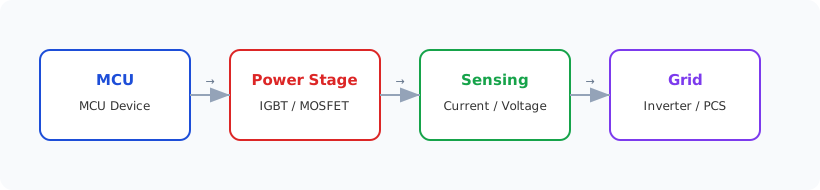
A string solar inverter begins with a DC-DC boost stage that implements maximum power point tracking, followed by a DC-AC inverter stage that feeds the grid. The boost stage switches at high frequency, so a Super Junction MOSFET such as the NCE60NF080F is the right choice: its charge-balance structure gives a 70 milliohm on-resistance at 41 A, and its 53 nC gate charge keeps the drive light, so the boost inductor can be small. The grid-tie bridge switches at a lower frequency, so a Trench FS IGBT such as the NCE20TD60BT works well, with a 1.7 V saturation voltage that keeps conduction loss low. Combining the two families is a common, cost-effective architecture.
Maximum Power Point Tracking
Maximum power point tracking squeezes the last watt from every panel. The boost stage switches at high frequency while the control algorithm adjusts the duty cycle to track the panel operating point under partial shading and passing clouds. High switching frequency improves tracking speed and reduces inductor size, which is where the low gate charge of the Super Junction MOSFET helps. A stable, low-loss boost stage also reduces the thermal load on the inverter enclosure.
Grid-Tie Bridge and Storage
The grid-tie bridge converts the DC bus to three-phase AC with low distortion and fast transient response. A low on-state voltage device keeps conduction loss small, and a low-inductance layout keeps the switching edges clean. For battery storage, a bidirectional converter both charges and discharges, so the same devices handle both modes and their efficiency and thermal behavior matter at every operating point. The Super Junction family's enhanced body-diode recovery reduces recovery loss in the bridge stage, which improves efficiency in both modes.
Compact and Micro-Inverters
A micro-inverter mounts behind a single panel, so space and thermal headroom are tight. A surface-mount Super Junction MOSFET or a small IGBT means the whole converter fits on a compact board, with the thermal path running through the PCB copper and thermal vias. The low gate charge and low on-resistance keep loss small in a confined enclosure.
Design Priorities
Keep the DC-link capacitor close to the switches, size the gate resistor for the EMI budget, and measure overshoot at the device terminals. Thermal design is equally important: use the on-resistance hot value for a MOSFET or the saturation voltage at temperature for an IGBT, add switching loss, and verify the junction-to-ambient path. The package must match the cooling available, whether a heatsink or the PCB copper.
Documentation and Supply
Renewable projects involve long lifetimes and strict quality audits. Every NCE Power device BeiLuo ships is factory-traceable and includes an import declaration, a certificate of origin and a RoHS compliance file, so procurement and audit reviews are straightforward. Mainstream devices are held in regional stock, and our FAE team supports device selection, gate drive, layout and thermal sign-off from the first prototype to volume production.
Conclusion
Solar and storage power conversion rewards efficiency, ruggedness and dependable supply. NCE Power Super Junction MOSFETs and Trench FS IGBTs deliver the electrical and thermal performance these applications need, and BeiLuo adds the authorized stock, documentation and engineering support that keep projects on schedule.